
Your Certified Employees May Not Be Ready When It Counts
CPR skills don’t last two years. Research shows they can be gone in three months.
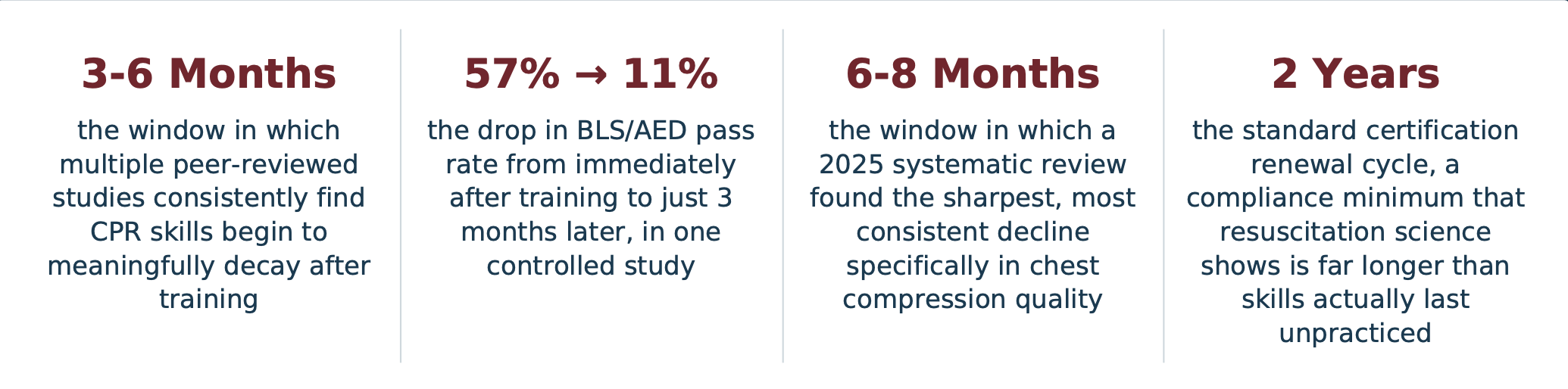
A controlled BLS/AED study documented a pass rate collapse from roughly 57% to just 11% within 90 days of certification. That’s not gradual erosion — that’s a cliff. For employers and safety managers in Cumming and across North Georgia, the data is unambiguous: a certification card is not the same as a skill that works under pressure.
The Work Readiness Center compiled and analyzed the latest peer-reviewed research to show exactly how fast CPR readiness fades — and what organizations can do about it.
The Gap Between Certified and Ready Is Bigger Than Anyone Wants to Admit
The standard approach to workplace CPR training follows a familiar pattern: certify employees, file the paperwork, schedule a renewal in two years. It looks like preparedness. The research says it isn’t.
A controlled BLS/AED study tracked trainees at two points — immediately after certification and again 90 days later. The results are hard to ignore. Pass rates fell from approximately 57% to just 11% over that single quarter. The 46-to-48-percentage-point drop means that the majority of employees who could demonstrate functional CPR skills the day they received their card could not replicate those skills three months later.
This isn’t an outlier finding. A 2025 systematic review confirmed correct CPR performance rates of 74% to 90% immediately following training — numbers that look strong on paper. But that same review identified chest compression quality — the single most mechanically critical component of effective CPR — as the fastest-degrading skill, with the sharpest decline occurring in the 6-to-8-month post-training window.
The decay is also granular, not just general. On a 17-point skills assessment, trainees performing nearly every component correctly right after class dropped to just 13.3 to 13.7 adequate skills by the three-month mark. Two to three missing skills in a real cardiac emergency aren’t abstractions. They are the difference between effective intervention and ineffective motion.
The structural problem is the two-year renewal cycle itself — a compliance threshold, not a scientific standard. As the Work Readiness Center documents, “CPR skills decay rapidly, within weeks to months after training, if not used or practiced.” The evidence-based alternative is clear: low-dose, high-frequency practice every one to six months produces meaningfully stronger retention than a single renewal class every 24 months.
For employers in Cumming and across North Georgia, this reframes the entire question of workplace preparedness. It’s not enough to ask whether employees are certified. The harder question is: certified as of when?
4 Key Stats
3 Takeaways for Employers and Safety Managers
1. The 90-Day Window Is Your Real Risk Threshold
Most organizations treat the two-year renewal date as the safety horizon. The data says the critical window is 90 days. Pass rates collapse from ~57% to ~11% within a single quarter — well inside most organizations’ planning cycles.
2. Chest Compressions Are the First Thing to Go
Compression depth, rate, and recoil degrade faster than any other CPR component. Knowledge-based refreshers won’t fix this. Hands-on compression practice, repeated at regular intervals, is what the research supports.
3. A Roster of Certified Employees Is Not a Safety Plan
Headcounts of certified staff measure compliance, not readiness. Track when employees trained relative to the 3-month and 6-month decay thresholds — not just when their cards expire.
“CPR skills decay rapidly, within weeks to months after training, if not used or practiced.”
— Antoinette Lewis, CEO, Work Readiness Center, Cumming, Georgia
That’s not a caution buried in fine print — it’s the central finding of the Work Readiness Center’s research synthesis. The implication for workplaces is direct: the moment an employee walks out of a certification class, the clock starts. Not a two-year clock. A weeks-to-months clock.
The research doesn’t leave organizations without a path forward. Practice intervals of every one to six months — short, structured, hands-on sessions rather than full recertification courses — are the evidence-based answer. Organizations that build this cadence into their safety culture aren’t doing more than required. They’re doing what the science actually supports.
About the Study
This report synthesizes peer-reviewed research on CPR skill retention, compiled by the Work Readiness Center in Cumming, Georgia. Core data draws from a controlled BLS/AED study documenting pass rate changes at certification and at 90 days, and a 2025 systematic review aggregating CPR performance data across multiple training cohorts. Findings are applied to the workplace safety context of Cumming and the broader North Georgia region. The report uses a narrative synthesis approach, identifying convergent findings across independent sources to establish the consistency and direction of CPR skill decay patterns. Source material spans peer-reviewed literature through 2025.
Frequently Asked Questions
Q: How fast do CPR skills actually decay after training? Research documents a pass rate drop from approximately 57% to just 11% within 90 days of certification. Chest compression quality — the most critical mechanical component — shows its sharpest decline within 6 to 8 months post-training. Skill loss begins within weeks, not years.
Q: Does the two-year renewal cycle keep employees prepared? No. The standard two-year recertification window was designed as a compliance threshold, not a scientific guarantee of readiness. The evidence supports practice intervals of every one to six months to maintain functional skill levels — far more frequent than the current industry default.
Q: What CPR skills degrade the fastest? Chest compression quality — specifically depth, rate, and recoil — degrades faster than other components. On a 17-point skills assessment, trainees lost the ability to perform 2 to 3 components adequately within just 90 days of initial training.
Q: What’s the evidence-based solution to CPR skill decay? Low-dose, high-frequency practice sessions every one to six months produce meaningfully stronger retention than a single renewal class every two years. Short, structured, hands-on refreshers — focused especially on chest compressions — are what the research supports.
Q: How can employers in Cumming and North Georgia address this problem? Start by auditing your workforce’s actual readiness window, not just certification dates. Then work with a training provider who understands the retention science and can support ongoing skill reinforcement — not just point-in-time certification. The Work Readiness Center in Cumming, Georgia offers programs built for exactly this purpose.
Don’t Wait for a Cardiac Emergency to Find Out Your Team Wasn’t Ready
The data is clear. The gap between certification and real readiness opens faster than most organizations realize — and it stays open as long as training is treated as a checkbox rather than an ongoing standard.
The Work Readiness Center helps employers in Cumming and across North Georgia close that gap with CPR training programs built around retention science, not just compliance calendars.