
The AED Coverage Gap Is Costing Lives — And Georgia Just Raised the Bar
Every minute without defibrillation cuts survival odds by 7–10%. Georgia’s new mandate requires more than a device on the wall.
Starting with the 2025 school year, every public K-12 school in Georgia must have an on-site AED and a written cardiac emergency response plan. Most states still have no such requirement. The survival data behind that decision is impossible to ignore — and the compliance standard is more demanding than most organizations realize.
Work Readiness Center helps schools and businesses in Cumming and across North Georgia build programs that actually meet it.
What the Data Actually Shows
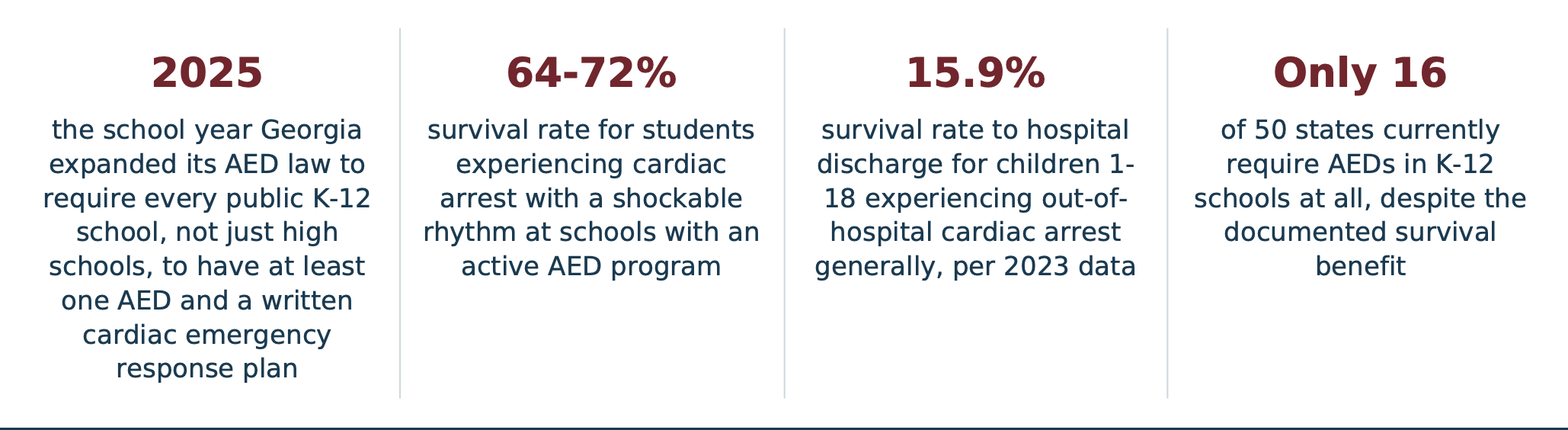
The survival gap between schools with active AED programs and those without isn’t a rounding error — it’s the difference between a 64–72% chance of survival and a 15.9% chance.
That gap has a simple mechanical explanation. Research published in the Journal of the American College of Cardiology documents that survival odds fall 7% to 10% for every single minute that passes without defibrillation. When a cardiac arrest occurs and someone has to wait for EMS, the average collapse-to-first-shock time is 12.9 minutes. When a trained bystander uses an on-site AED, that window compresses to 3.3 minutes. Nearly 10 minutes of additional time without a shock — in many cases, that’s the outcome.
The national policy picture makes that gap worse. Despite decades of research, only 16 of 50 states require AEDs in K-12 schools at all. Georgia’s 2025 expansion — extending an existing high school mandate to cover every public K-12 school — places the state in a distinct minority nationally. But a legal requirement and a functional program aren’t the same thing. A 2017 analysis found that of the 16 states with school AED mandates, only 5 offered any dedicated funding to help schools actually purchase devices. That turns a life-safety requirement into an unfunded mandate that resource-constrained districts may struggle to meet — let alone surround with the training, maintenance, and planning infrastructure that makes a device usable in a real emergency.
Georgia’s rule is specific about what compliance actually means: documented device maintenance, trained personnel, written placement protocols, and a formal cardiac emergency response plan. Good Samaritan liability protection for responders is conditioned on meeting the full standard — not just owning a device. For North Georgia schools and businesses, that distinction matters.
4 Key Stats
3 Takeaways for Residents & Organizations
1. Owning an AED Is Not the Same as Having a Program
Georgia’s mandate requires maintenance records, trained staff, placement protocols, and a written response plan. A device that hasn’t been serviced — in a location no one knows about, in a building where no one is trained — does not meet the standard and may not provide the legal protections your organization is counting on.
2. Every Minute Is Measured in Survival Percentage Points
The physiology doesn’t negotiate. For every minute defibrillation is delayed, survival odds drop 7–10%. Bystander response with an on-site AED cuts response time by nearly 10 minutes compared to waiting for EMS. That time gap is why training the people already in the building is non-negotiable.
3. Workplaces Aren’t Off the Hook
Schools face a new legal mandate — but workplaces operate under OSHA’s General Duty Clause without any federal AED requirement. That doesn’t mean the risk is lower. It means liability exposure varies by state and industry, and North Georgia businesses that wait for regulatory pressure to act are taking a gamble the data doesn’t support.
“Having an AED on the wall and having a compliant, functional program are not the same thing. The gap between those two is exactly where real liability — and real risk to human life — lives.”
— Antoinette Lewis, CEO, Work Readiness Center, Cumming, Georgia
The distinction matters legally and practically. Georgia’s Good Samaritan protections are conditioned on full compliance — not partial compliance. Organizations that treat AED readiness as a one-time purchase rather than a living program may find themselves exposed on both fronts: unprotected legally, and unprepared when it counts most.
About the Study
The School and Workplace AED Coverage Gap was produced by Work Readiness Center, a CPR training and certification provider serving Cumming and North Georgia. The report synthesizes peer-reviewed research from the Journal of the American College of Cardiology, a systematic review of state AED legislation, and Georgia’s 2025 K-12 cardiac emergency preparedness mandate. It was developed to help schools, businesses, and community organizations understand their current compliance standing and the real-world stakes behind AED program readiness. No primary survey data was independently collected. All statistics are sourced directly from the cited literature.
Frequently Asked Questions
1. What exactly does Georgia’s 2025 AED mandate require? Every public K-12 school in Georgia must now maintain at least one AED on-site, along with a written cardiac emergency response plan. Compliance also requires documented device maintenance, trained personnel, and established placement protocols. Previously, this mandate applied only to high schools.
2. Does Good Samaritan protection automatically apply if we have an AED? Not automatically. In Georgia, Good Samaritan liability protection for AED responders is conditioned on meeting the full compliance standard — including maintenance, training, and a written response plan. Simply owning a device does not guarantee that protection applies.
3. Are workplaces in Georgia required to have AEDs? There is no federal AED mandate for workplaces. Employers operate under OSHA’s General Duty Clause, which requires a safe workplace but doesn’t specify AED requirements. Liability exposure varies by state and industry. North Georgia businesses should proactively assess their readiness rather than wait for a specific mandate.
4. How significant is the survival difference between schools with and without AED programs? Significant. Research published in the Journal of the American College of Cardiology documents 64–72% survival for students with shockable cardiac arrest at schools with active AED programs, compared to 15.9% for out-of-hospital pediatric cardiac arrest without immediate on-site defibrillation. That gap is driven by response time — specifically the nearly 10-minute difference between bystander AED use and EMS arrival.
5. How can Work Readiness Center help our school or business get into compliance? Work Readiness Center helps organizations in Cumming and across North Georgia build complete AED programs — including personnel training, maintenance protocols, placement planning, and written cardiac emergency response plans. Contact them directly to assess where your organization currently stands.
Your AED Program Has Gaps You May Not Know About
Georgia’s 2025 mandate is in effect. The compliance standard goes well beyond owning a device — and the survival data makes clear that a half-measure isn’t good enough.
Work Readiness Center builds complete, compliant AED programs for schools, businesses, and organizations across Cumming and North Georgia.